A First Visit to a Public Art Trail, at Your Own Pace
Plan a first visit to a public art trail with a short route, practical ways to notice each work, and room to pause without racing the map.
You reach the trail map, spot a dozen dots, and feel the walk turning into homework. A first visit to a public art trail can be smaller than the map suggests: choose a few works, notice what surrounds them, and let the route breathe. The aim is not to collect every stop. It is to spend enough time with a handful to understand how the art meets the place.
Before you go, choose a loose shape for the visit
Begin with the trail’s own map, printed or online. Look for the starting point, the locations of works, and any route notes. Some trails follow a clear path; others connect pieces across parks, streets, or civic buildings. You do not need to settle every detail in advance. The useful question is how much attention you want to give the outing.
Pick a small cluster rather than plotting a full circuit. Three works can make a satisfying first visit, especially if they are close enough to leave time for looking around. If the trail covers a larger area, select one section and treat the rest as a reason to return. A limited plan is permission to linger, not a test of endurance.
Check the practical details that could shape your route: opening hours for any indoor locations, access notes, transit or parking options, and whether the map marks temporary closures. A sculpture beside a path may be viewable at any time, while a work inside a library or station may follow that building’s schedule. Use the information provided by the trail organizer or site.
Bring only what helps you feel at ease: the map, a charged phone if you use a digital guide, water, and weather-appropriate clothing. You can read interpretive text as you go, but you do not have to study every description before arriving. Let the work have a first impression of its own.
At the start, let the surroundings set the pace
When you arrive, pause at the trailhead or first meeting point. Find your bearings before heading off. Notice the paths, crossings, entrances, and places where people naturally slow down. This is not a hunt for clues. It is a way to see that a public artwork shares space with ordinary movement.
Check the route against what is on the ground. A path shown on a map may feel different in person: a busy crossing may call for a detour, a shaded path may invite a slower walk, or a crowded gathering spot may be better approached later. Follow public signs and keep clear of entrances, ramps, and the flow of people using the space.
At the first work, give yourself a moment before reading its label. Notice its scale, shape, surface, color, and position. Is it low or high? Does it face a path, a building, or an open area? Does it seem close to the street or set apart from it? These simple observations help you meet the work where it stands.
Then look outward. The nearby paving, trees, windows, street furniture, and sightlines all help explain how the work occupies the site. A reflective surface may change with passing light; a low form may sit within the same field of view as a garden edge. You need not decide what the artist intended. Just observe what is there.
Spend a few minutes with each chosen work
A useful rhythm is to look first, read second, and look again. Start with the work itself. Then read any nearby label or trail note, if one is available. Return your eyes to the work and see whether the text draws attention to a material, detail, or relationship you had not noticed. If the label is missing or difficult to access, the visit still counts.
Move around only where the public path allows it. A change of angle can reveal a gap, a shadow, or a view through the piece. Do not step into planted areas, climb on a sculpture, or block a busy walkway for a better look. Sometimes one clear view is enough; sometimes the work changes as other people pass.
Give the surrounding activity equal respect. Someone sitting nearby, a child passing through, or a person using the route is not part of a display for you to study. Let other people keep their privacy and room. The point is to notice how a work shares a setting, not to turn its users into scenery.
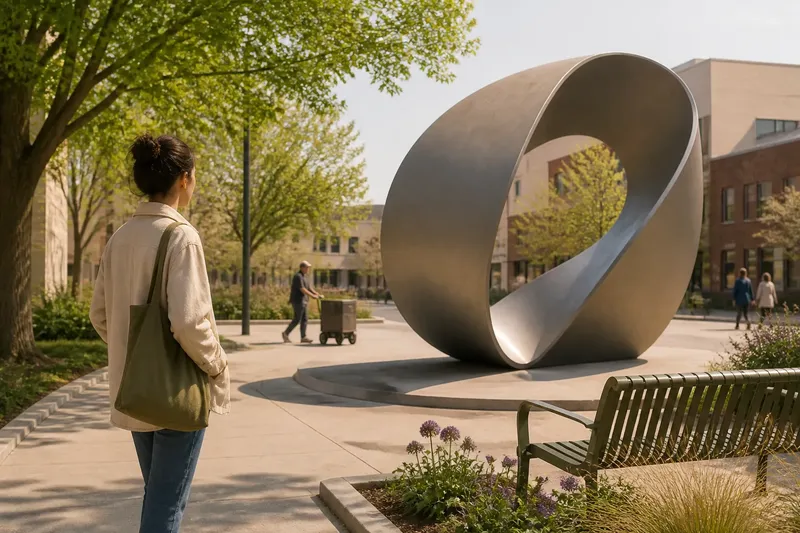
Say you arrive at a metal sculpture beside a small plaza and find a delivery cart passing through. You step to the edge of the path, look at the piece from the open side, and notice its shadow crossing the paving. After the cart moves on, you take a second look from the bench without occupying it for long. The expected result is a fuller sense of the sculpture’s place in the plaza, without interrupting anyone’s route.
Use pauses as part of the route
Public art trails often lead through places that already have their own uses. A pocket park may offer a quiet seat; a plaza may be lively; a path beside a road may be noisy. You can pause where it feels comfortable, but you do not need to stop at every work or spend the same amount of time at each one.
If you feel tired or distracted, shorten the route. Sit where seating is available, step aside for a drink, or skip a stop and head toward a transit point. A pause can also mean simply standing safely out of the way and watching how the view changes. There is no need to turn rest into another task.
When a work is crowded, give it space and consider returning after another stop. If a location feels uncomfortable or inaccessible, choose a different work instead. The map is a tool, not an order. A pleasant first visit is one you can adapt without having to justify the change.
Keep an eye on ordinary site boundaries. Do not enter fenced areas or restricted buildings to get closer. Where the route crosses streets, use marked crossings and follow local signals. If access details depend on a site’s current conditions or rules, check the organizer’s information before setting out.
Notice how the trail connects works to place
As you move between stops, ask what changes. Does the path shift from a quiet garden to a busy civic block? Does one work sit alone while another shares a view with shops, trees, or a public building? The gaps between artworks can be as revealing as the pieces themselves. They show how the trail threads through everyday space.
You might compare how each work meets its setting without ranking them. One could be easy to spot from a distance; another may become visible only as you approach. One might invite a broad view, while another draws attention to a small detail at ground level. These differences can help you understand the trail as a sequence of encounters rather than a row of objects.
Notice where your own pace changes, too. You may walk briskly between works, slow near a shaded path, or pause because a view opens unexpectedly. That response is useful information. It can shape which section you revisit, or whether you prefer a trail with open gathering places over one that follows narrow streets.
How can you make an overwhelming trail map manageable?
How many works should I choose for a first visit?
Choose a small cluster that fits the time and energy you have, rather than aiming to complete the whole map. For instance, say your map shows a cluster of three outdoor works near a park entrance and a farther stop inside a civic building; choose the three nearby works, walk to each, and leave the indoor stop for another day if its hours or distance complicate the route. The observable result is a shorter outing with time to look at each work, while the tradeoff is leaving part of the trail unexplored.
Should I read every artwork description?
No. Look at the work before reading, then use the label if it adds context you want. A missing label does not prevent you from noticing the piece and its surroundings.
What if I cannot find a work?
Check the map and any route notes, then look from the public path without entering restricted areas. If the location remains unclear, skip it and contact the trail organizer later if you want updated directions.
Can I visit a public art trail alone?
That depends on your comfort, the route, and the conditions at the time. Review access and transit information, choose a route that feels manageable, and let someone know your plan if that helps you feel more at ease.
After the walk, keep one observation
At the end of the visit, take a moment to remember one detail: the way a surface caught the light, the sound near a work, or the change from a busy street to a quiet path. You might write a short note, mark the works you visited, or leave the map folded in your bag. No formal review is needed.
If you want another visit, make the next plan from what you noticed. Return to a work at a different time, choose a nearby section, or invite someone whose pace suits the route. A first visit to a public art trail works best as an opening, not a completion badge: leave one unvisited stop for another day, and the map will still have something to offer.